Welcome to: Artist Diary: Part 4/5 , this day one of a 5 day project where we discover 5 ways to fill a blank spread in 10 minutes.
This project is the first the second of 3 projects of “Start a daily drawing habit: a Gameplan”, go here for the full table of contents.
A note on the assignments: If you’ve done the Ten Minute Visual Journal Method, you are going to recognise this format. I spend 5 whole days talking about it here. And you can feel free to dig into that. I just felt that this Artist Diary project would be incomplete if I don’t mention the method. This is my go to daily format, and no matter what else I’m doing I will always try to sneak in these four panels.
Welcome to day 4:
Comic Diary
I find that adding structure—through repetition, rhyme, and color—makes my ordinary, individual experience interesting to others.
Most of what we’ve done so far creates a kind of personally satisfying but sometimes in coherent rambling sort of work, or at least that is what it’s supposed to do.
A comic does something different.
A comic is a specific orderly format to present and idea. For much of my childhood life the comics page was my only contact with ideas from the outside world. And what a divers set of ideas they were, all presented side by side in this neat package.
Now whether you create comics for private consumption or to share, I’m going to give you a way to filter your daily experience, into four tidy boxes, even if you only have ten minutes.
This practice will help you mine your subconscious for your best ideas and preserve moments forever, imagine looking back at each day of your life as little comics. Imagine weeks, flipping through months and years of comics that you drew yourself just for yourself.
Storytime….
Some years ago, just before I became an (award winning) picturebook illustrator, I had forgotten I was an artist.
As someone who spent most of my childhood and adult life identifying as an artist, it might seem absurd that this could even be possible. But it really did happen, it took and anxiety attack fuelled burnout and chance encounter with my cousin who trained as a psychiatrist to literally remind me that there was an artist inside me.
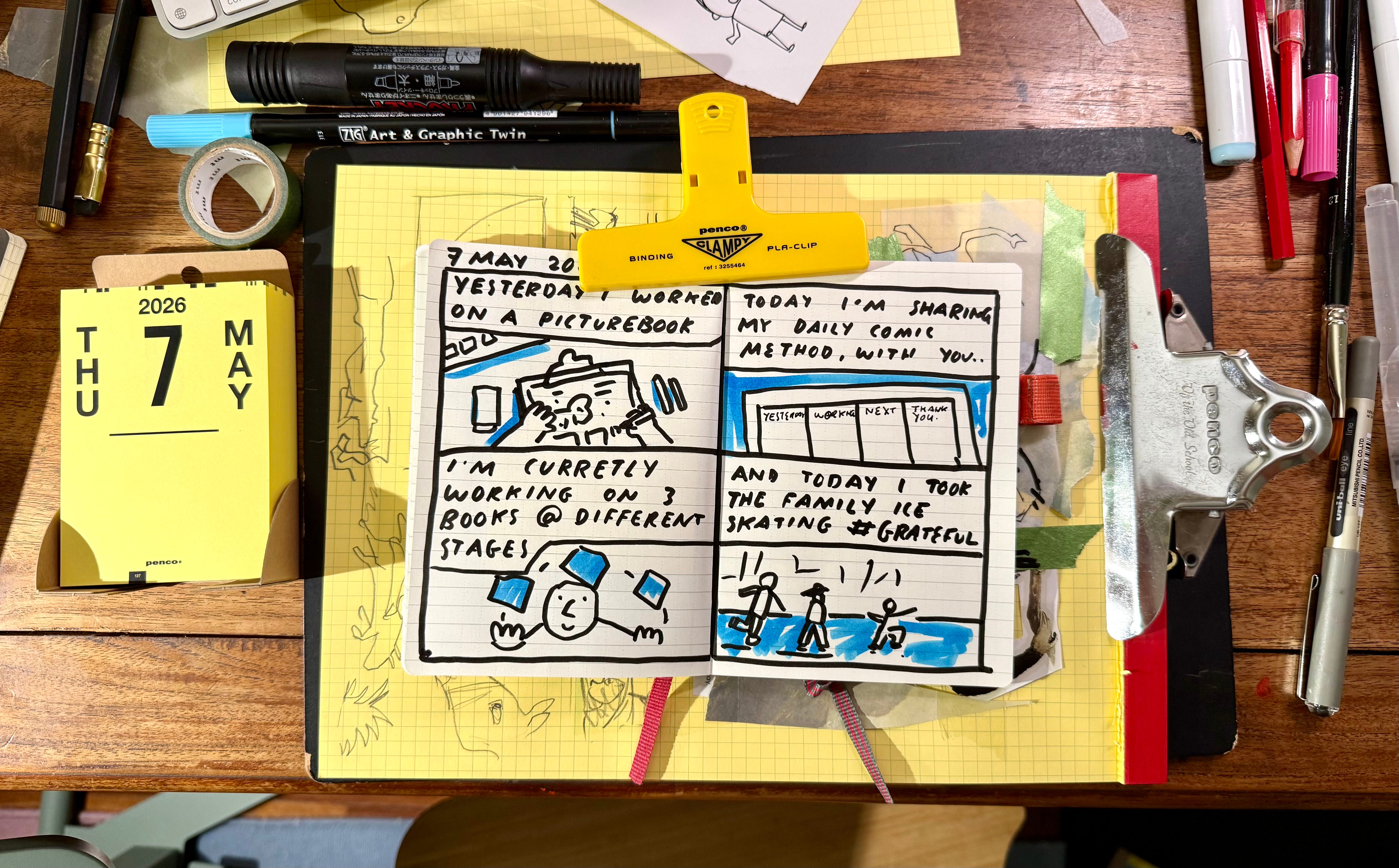
And the act that cured me, or helped me return, and eventually end up finding a path to my dream job was the daily practice of creating a comic strip. This act also helped me ‘survive’ the pandemic, and turn it into something useful. The comic I made and put on the internet resulted in my first offer to illustrate a book. — largely because the author could relate to the personal work I was doing.
I had not such a clearly defined method then, but I managed to streamline it through the years.
Another reason I find this method so useful, is it creates all kinds of situations to write and draw about. You will be assigning yourself 4 very specific things to draw daily, and the repetition of the questions will challenge you to approch them differently daily, and you will learn so much about how to tackle these prompts daily.
The solutions you come up with can be the same solutions you use in client work.
Do these prompts regularly and over time they will shift and change to suit you this shifting and shaping is the illusion process of ‘discovering’ your style.
Which is… your way of working, your sensibility, the thing you have to say
As much as I try to sell it, the only way to see the benefit of this practice, is to do it.
Shall we?
Daily Comics (or The Ten Minute Visual Journal Method)
4 simple questions to center you in the present moment and capture it in words and pictures.
You can do this anywhere.
Sometimes I do it on a napkin, other times I take a page or even a whole spread out of an artist diary or sketchbook, the point is just that you do it.
I’m going to show you one way, but of course feel free to customise it to your particular notebook, journal or sketchbook.
The Basic Setup
Set a timer for 10 minutes then do the following steps
Step 1
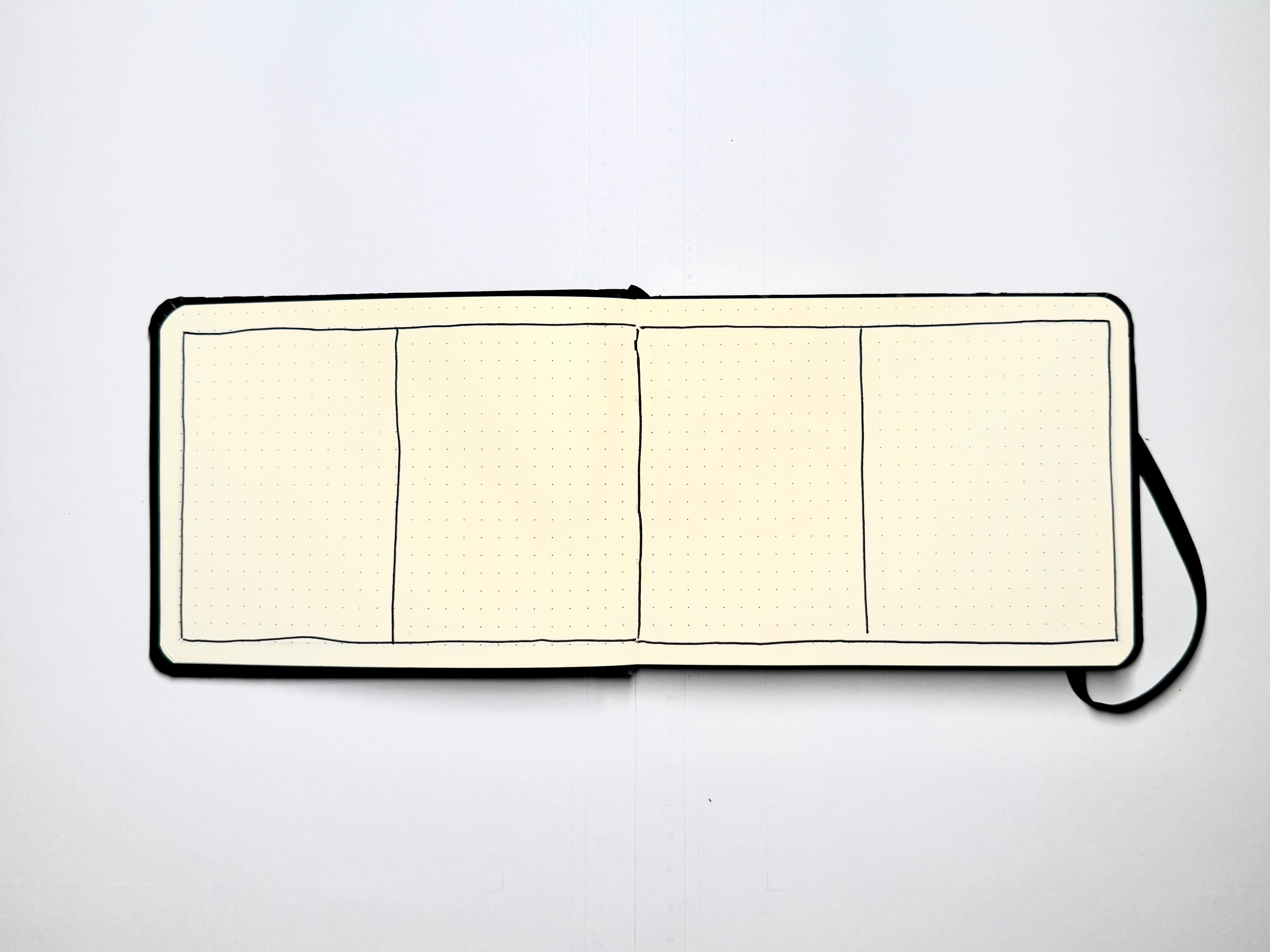
Start by drawing a frame around the entire area you want to use. Then splitting that area into four. You should end up with what looks like a comic panel
Step 2
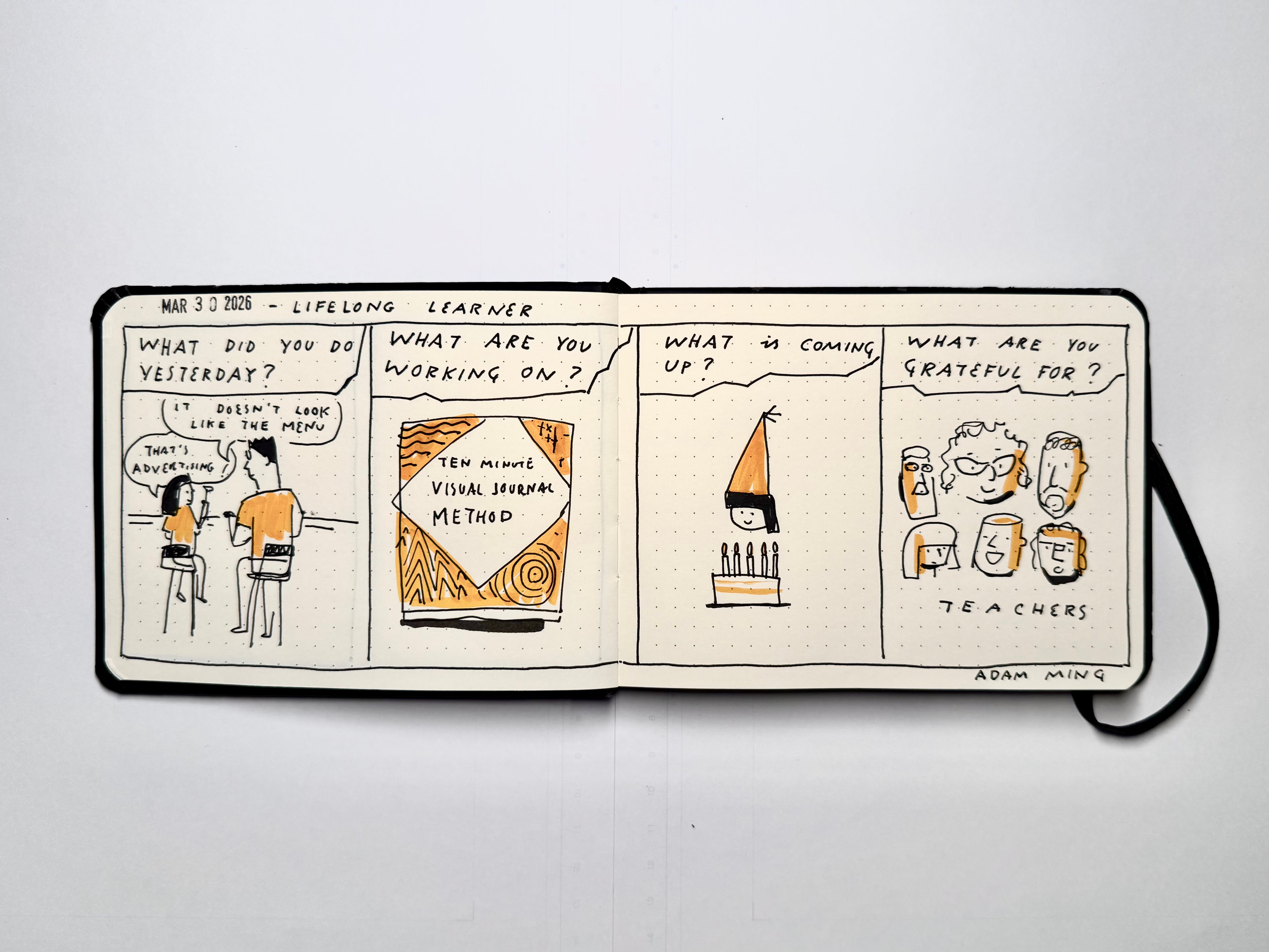
Write one of these questions in each of the boxes, leave space to draw or add additional text.
What did you do yesterday?
What are you working on?
What’s coming up?
What is one thing you are grateful for?
Step 3
Answer the questions with words and images.
You could use a combination of images or words to answer each question. You can use it to experiment with different materials. You could experiment with lettering. You could draw yourself as a bird, anything goes.
The result will be something like a daily comic strip or a daily feed that you create for your self.
Step 4
Write or stamp the date.
Step 5 (bonus step)
Write a short title or caption for the comic.
Advanced Setup
You can position the questions in any of the boxes and answer them in any order, a different sequence might spark different ideas.
Once you find a sequence that works for you, I suggest keeping in because the sequence you use to answer the questions will become a kind of meditation.
Once you get familiar with the questions you don’t actually need to write it down, you can just write and draw your answers.
Use this Chat as a gallery to share your work and get to know the others. Everyone here is starting their day with a daily drawing habit, and we’re all grateful for the opportunity to go on this adventure together.
This Gameplam is now available to all paid subscribers of Ten Minute Artist.
I’ve temporarily reduced the annual subscription of the newsletter to $50, but the price will go back up to $100 in on September 1st.
Once you subscribe you will get access to
2 Gameplans:
Start A Daily Drawing Habit (3 projects)
Start Earning True Fans (3 projects)
I will personally guide you through these projects by sending you a quick reminder each day, but you can also take the projects at your own pace whenever you’re ready.
Paid subscribers also get a new Ten Minute Artist project each month, these will add novelty and momentum to your practice and serve as an on ramp if you ever fall off.
So if you want to save $50, start a daily drawing habit and become part of the Ten Minute Artist Community.





This is great, Adam!