This post is part of a 60 day creative program called Gameplan, I made this post free, because I felt it was too important to paywall. If it helped you, please consider sharing, and if you’d like to join this epic journey that I’m creating for 400+ paid subscribers, we would love to have you!
This is day 4 of How to Draw Anything, today’s dispatch is titled Hidden Characters. You can check out the entire Gameplanhere.
Author Notes: One of the differences to writing this program as a newsletter rather than a book is that I can interact with you in real time.
I get to see how you’re responding to the assignments, and I get your emails with questions.
I remember when I was doing my first picturebook course, I felt so lost, It was like being at a 12 course meal, getting served course by course and not knowing what was coming next.
Is the next thing going to be sweet or savoury.
Will I like it?
Will I still be hungry by the end of it, I wonder if there will be meat, or seafood, or maybe some pasta.
Am I doing this right. What is the point of this all?
In the assignments thread I see a lot of you are having fun, some enjoying the process and some struggling with certain things and pushing through.
All of us are here for different goals and I think the most common ones are.
You want to build a practice that you continue indefinitely.
You want a space for some personal work amidst professional work
You want to get paid gigs. And you want to know how this is going to get you there.
I’m going to take some space today to answer the third one. If you’re in that position I hope it will give you a sense of how things fit together, and if you’re not in that boat, you might still find it of interest.
When I took a course in illustrating children’s books in 2020, it was the first art related course I took since graduating art school in 2000. And my goal then was to be a Full Time Picture Book Illustrator.
I reached that goal (hold the applause)
I’m not sure it was the best goal. I have no regrets, and I am very proud of the accomplishment. I seem to have an indefinite amount of childrens book projects ahead of me.
I think it’s a mistake to think, that being a working artist means, you get to do ONE type of a creative job for 8 hours a day, 5 days a week. And I have been thinking about this for awhile. But yesterday I got a chance to speak to Andy J. Pizza via his Creative Pro Talk, and in a group we explored this topic through a variety of lenses.
One of them being that if your dream is to be a painter, painting whatever you want for 8 hours a day is probably not going to be a realization of that dream. Most creative people can sustain 2-4 hours of creative output a day.
This is taxing work.
A way that seems to work for many freelance artist over a long period of time is to have separate streams of incomes. This is not something that can happen over night, but is built strategically over time. Someone suggested the way to think about it is having multiple categories of income.
Some people have a part time design job, or maybe an art adjacent job. When I decided to become a children’s illustrator, the first thing I did was get a part time job. Spending that 1 day a week in a corporate job, bought me time to work on my portfolio and my first books, and paid the bills while I waited for the irrational advances to come through.
Writing this is not a massive money maker, but I love sharing what I do and connecting with all of you and that trickling income does help plug the gap between book payments.
And even now I’m building other income streams for my creative work, and continuing to take courses and seek guidance from people far ahead of me.
So to bring that back to the person who needs to make money right now. I would say, step one is to get a job. My part time job was to design app interfaces and interview customers to understand how they use an app. I know people who, work at museums, design wedding cards (Katie Stack ), sell products and markets (Jen Gubicza), while they create their own work, some do graphic design or work as a nanny.
It is difficult to rely on you new creative endeavour as a primary source of income, you’re learning the ropes. That’s why we started this journey with sacred time.
If you can’t become that high voltage version of yourself and have unlimited creative energy for 10 minutes a day, then how to find an art director is not going to help you, that’s the easy part.
The hard part, is living like an artist.
To do the thing even if it’s for only 10 minutes a day in the beginning, then you need to figure out what YOUR unique thing is that is also valuable to someone else. There must be that overlap of someone desperately needs something that you are utterly passionate about.
That is the goal we’re building towards. One step at a time over 6 projects. Then over a 1-1 discourse. So hang in there, enjoy the process, and if you need to, get a job.
I’m not saying this to sound harsh, only to be as helpful as I can possibly be.
Then let’s build a creative practice, that grows into a creative business, maybe multiple creative businesses, freelance or otherwise. And if you’re happy to stay at Creative Practice, that’s fine too!
Onward!
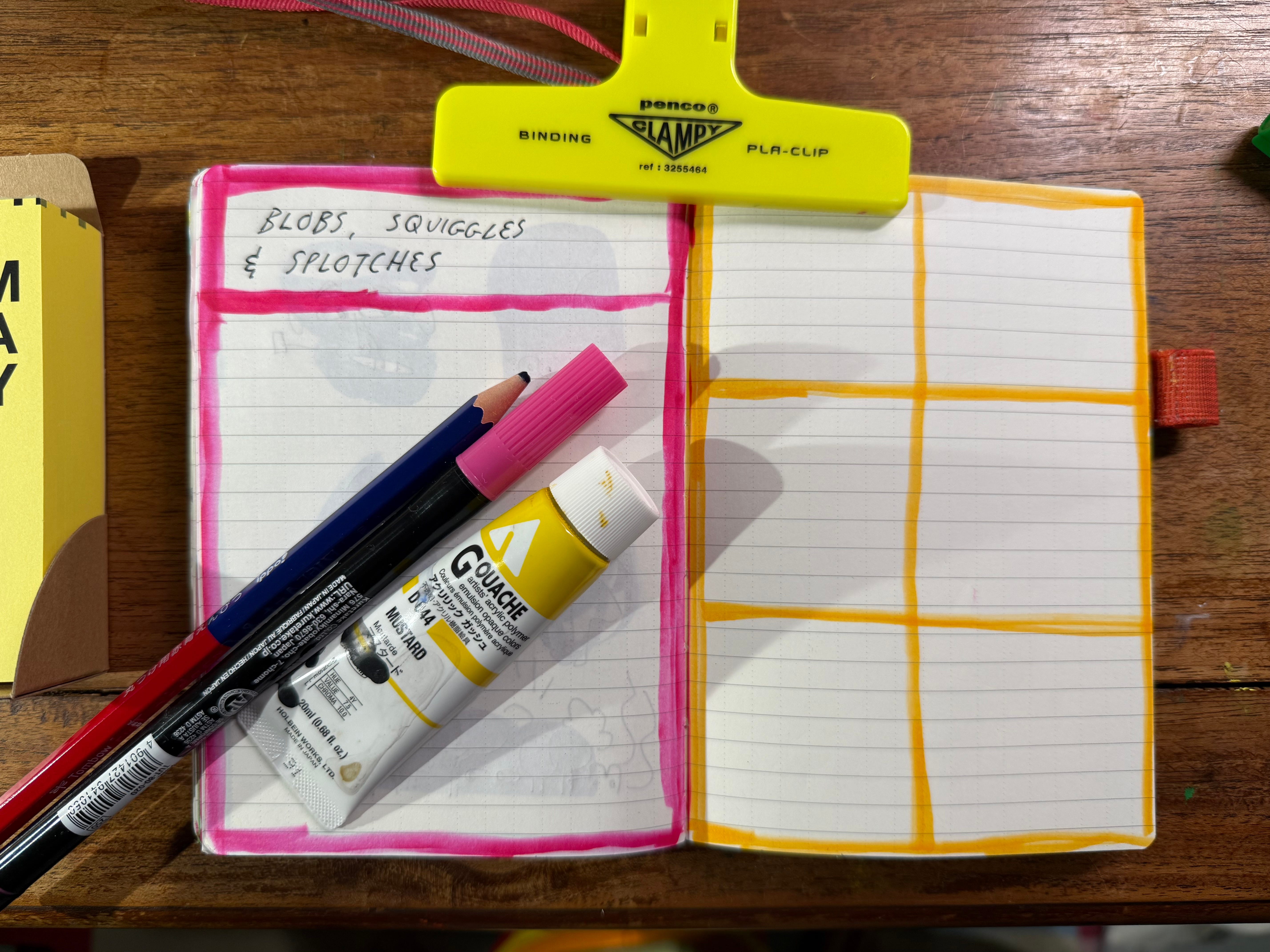
Project Notes: For this project divide your spread into two sections. We will use the right page for the Art Assignment, and the left page for notes.
This project is meant to supplement your daily art practice rather than replace it. It will give you tools to tackle your daily practice with more confidence and skill. I will leave it to you to decide how you will make time for this extra practice.
Welcome to day 4:
“It’s the feeling of playing with a toy that plays back”
— Lynda Barry
Find Characters
Everyone has their own version of this practice.
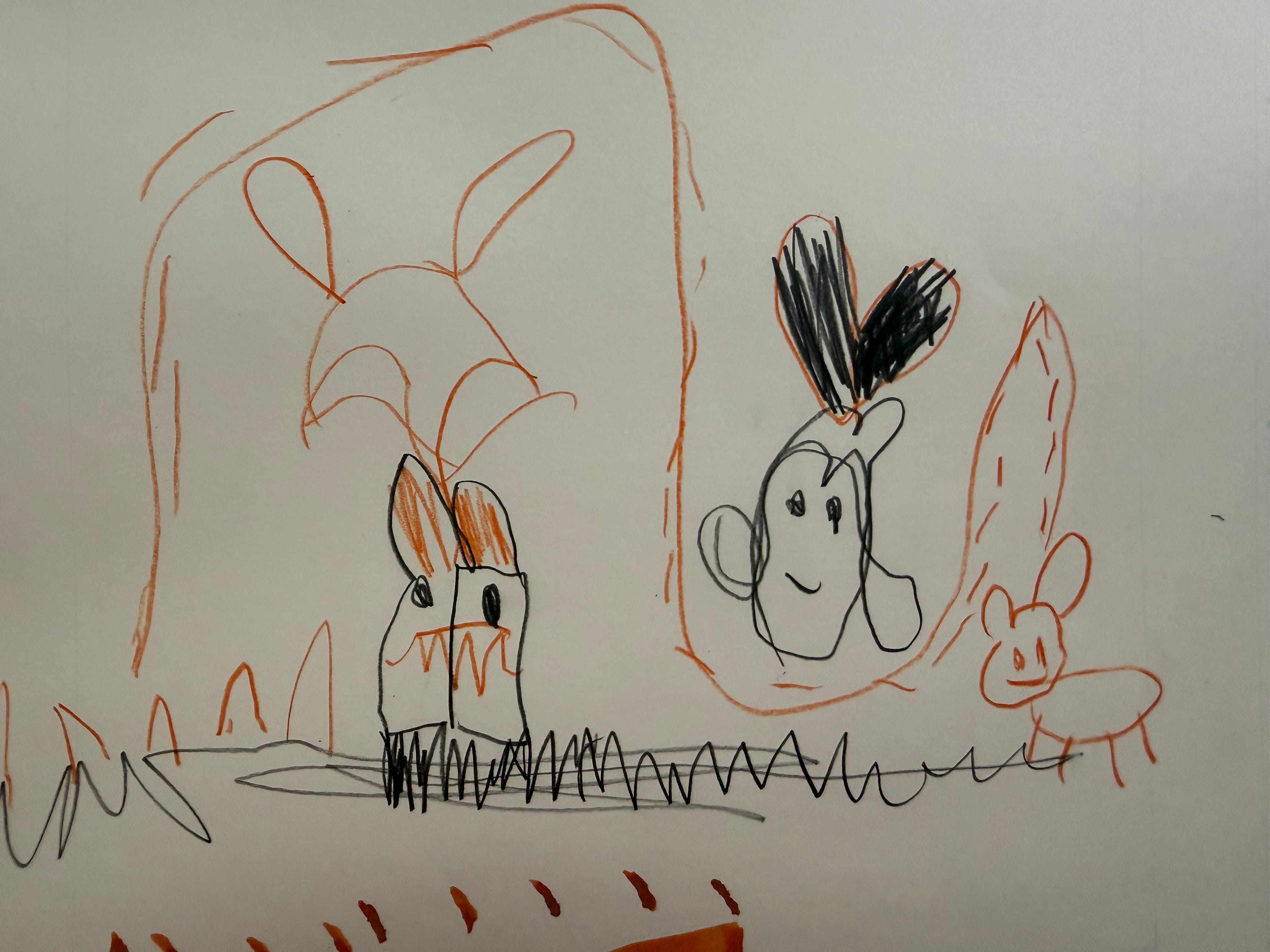
In fact, this is how we all start to draw. I live with a 5 year old I’ve seen it happen in real life.
“This is a bunny”
“The bunny wants to get to the carrots, but there is a monster in the way, the bunny jumps over the monster”.
Sometimes, I leave the door to the studio open and let the 5 year old come in and draw on her own. You overhear conversations with the drawings. We have this natural ability to start with marks, decide what those marks mean.
The marks become characters, characters you can play with and who play back.
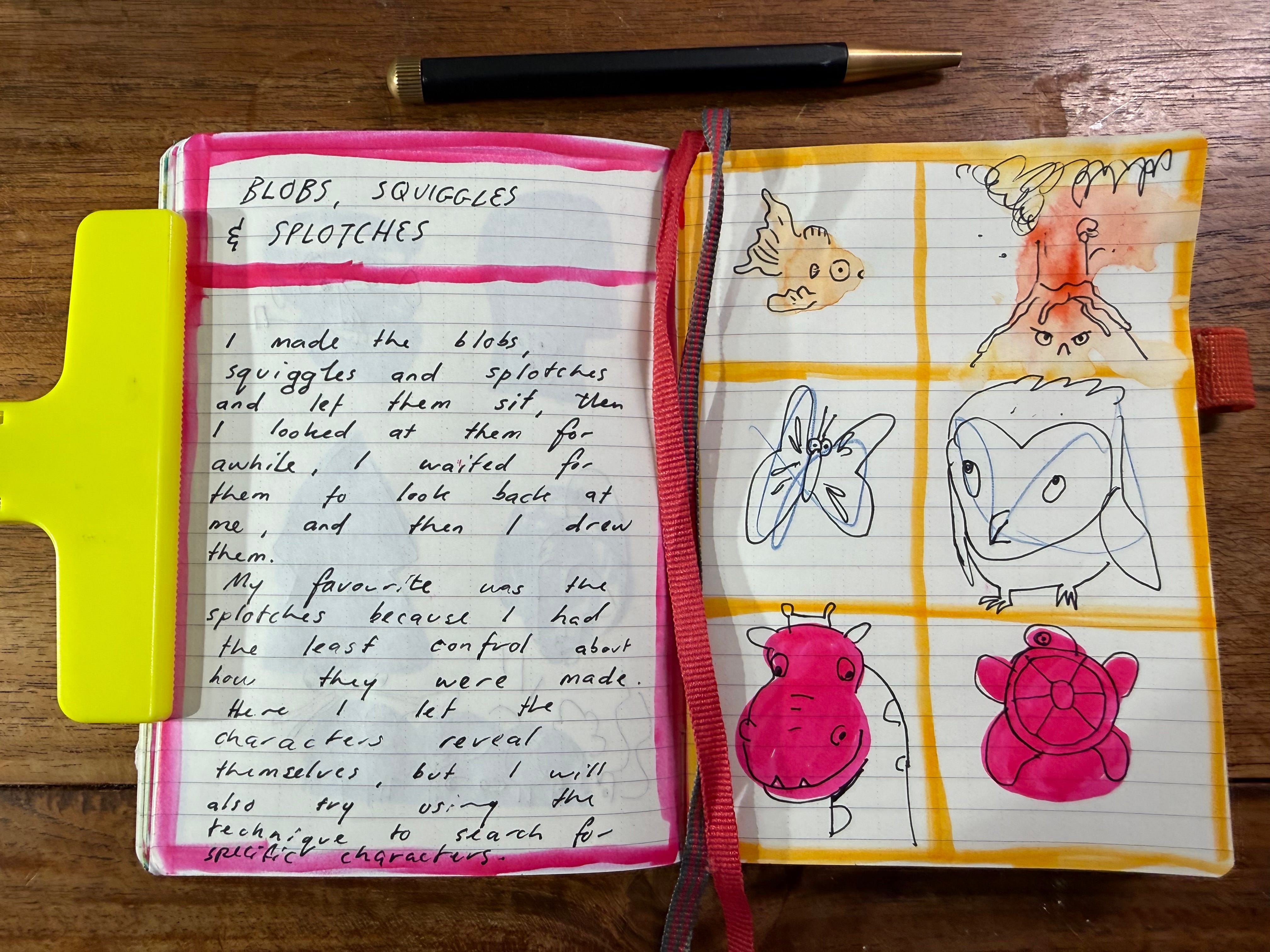
Assignment 14: Splotches, Squiggles and blobs — Finding characters
We begin in the usual way, leaving a page for notes and a page for the assignment, in the assignment page, create a grid of 6 squares
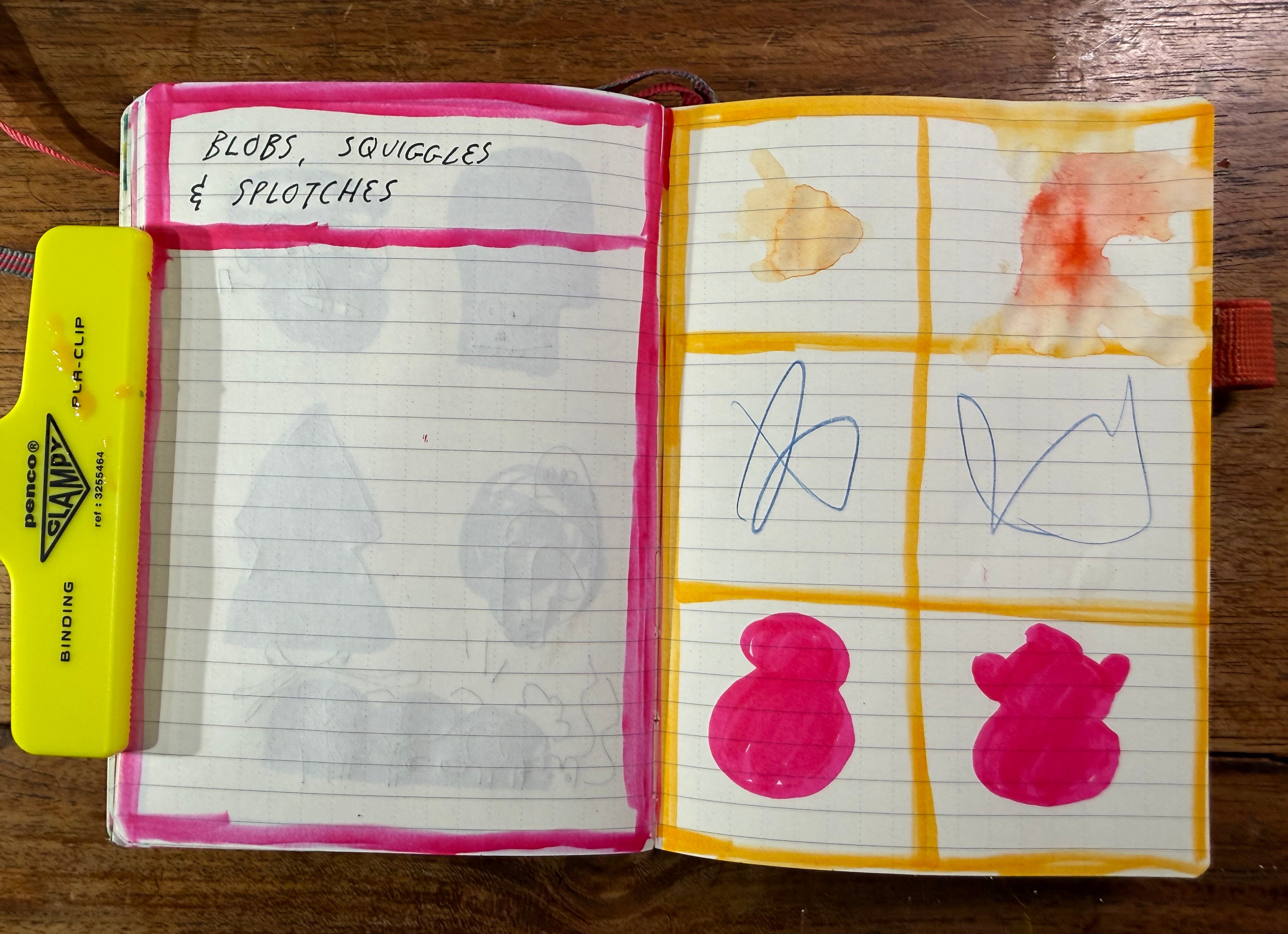
Then make 2 blotches, 2 squiggles and 2 blobs.
Like so…
Take Time to look at each frame, really look, look until something looks back at you, then draw its eyes. Once you have that, draw the rest of the character.
You might end up with something like this. Now in the notes, the natural thing to do like what I have done is comment on the process, what you like, what could be better, all the usual stuff.
Instead of doing that, try asking the characters some questions.
Where are you going?
Why the face?
What are you scared off?
Can I help you?
Is there something you want to tell me?
What are you looking for?
What’s your name?
If you did that… Wow.
Look at yourself, you just drew like a 5 year old. You also used some random marks and turned them into characters even the beginning, or middle of stories. Maybe you even made a friend.
In 10 minutes. Yeah, you have incredible talent, and so much inside of you that is longing to come out. This is the part of the process we are at, getting good at letting all that good stuff flow.
Later on we can figure out how to put it in a box and put a price tag on it. Cheers! You now know how to creat characters.
Share your assignment in the Gameplan Chat below. The chat also serves as a gallery.
PS: All the dispatches and assignments will be made available in one place, and that is the post called “Your Gameplan”, you can check back there for links to all the dispatches and assignments as they become available.
I just wanted to say thank you for being so willing to share your knowledge and to take the time to help others along their path towards a creative life and career. I am really grateful that I joined in your substack when I did! The Gameplan series has been incredible. I have learned so much more about who I am and who I want to be because of it.
Yay blobs! I've always started workshops w/ that kind of "finding" exercise -- It reminds us that imagination (finding narrative in noise) is NOT a "talent" but a species-wide survival skill!
(Oh & "Leave the door open & let the 5-year-old-in" is the best ever creative advice.) ❤️🔥





I just wanted to say thank you for being so willing to share your knowledge and to take the time to help others along their path towards a creative life and career. I am really grateful that I joined in your substack when I did! The Gameplan series has been incredible. I have learned so much more about who I am and who I want to be because of it.
Yay blobs! I've always started workshops w/ that kind of "finding" exercise -- It reminds us that imagination (finding narrative in noise) is NOT a "talent" but a species-wide survival skill!
(Oh & "Leave the door open & let the 5-year-old-in" is the best ever creative advice.) ❤️🔥