



Every month I drop a new 5-Day project, to help you add some variety to your daily creative practice, or to serve as a ramp to gently invite you back in if you’ve fallen off. Whether you make art for the pure joy of it or if you’re a working creative professional, I encourage you to try a Ten Minute Artist practice.
The practice of creating something for yourself daily, even if only for ten minutes.
In this project we’re going to talk about MAKING COMICS
One last thing before we begin: I’m starting another cohort for Gameplan: How to be an Artist on July 6th and you can get a preview by turning that on here.
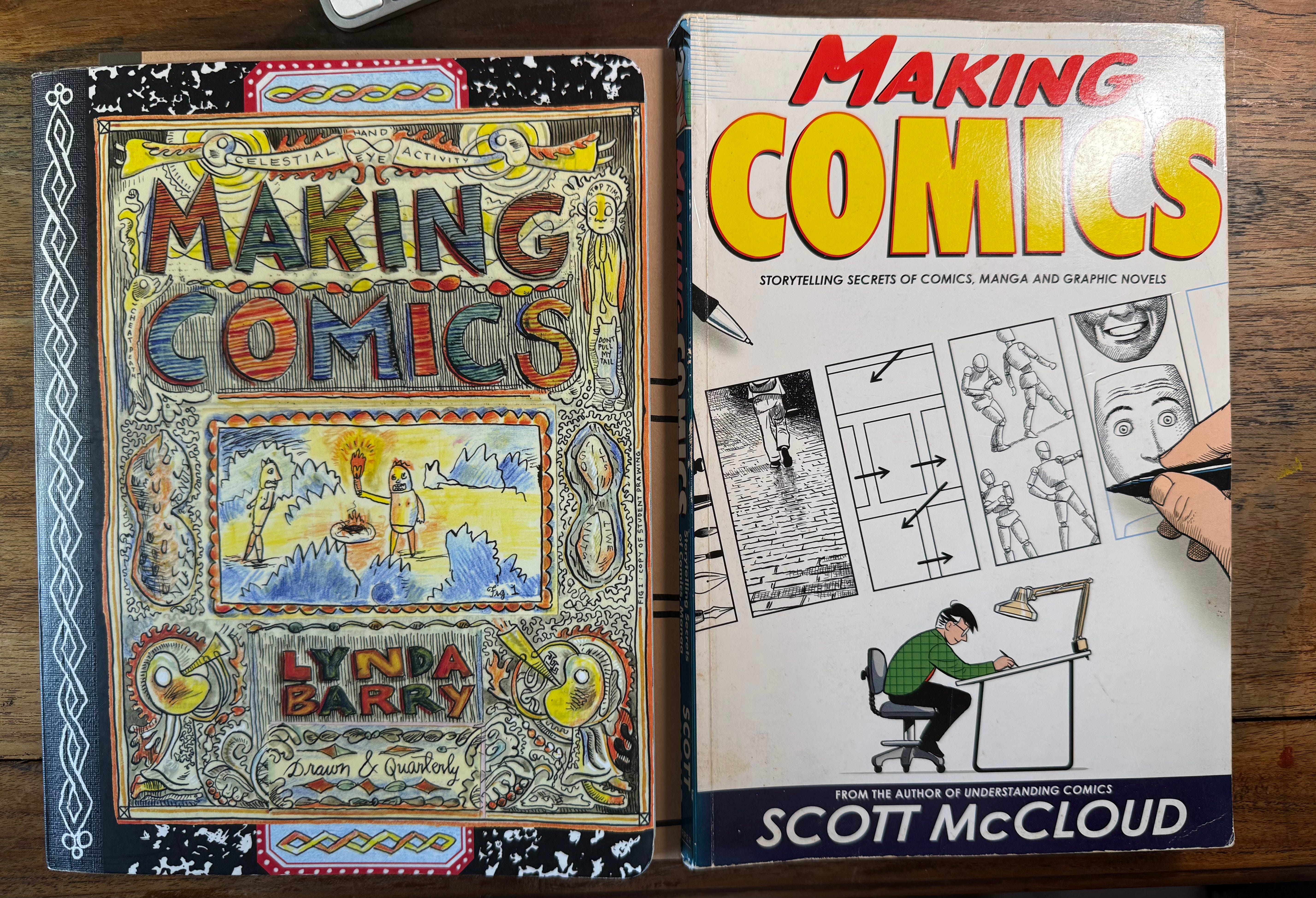
Welcome to Day 1 of : Making Comics
In the image above you will see two books I bought with the same title 16 years apart. I started with the Scott McCloud book, because that was the one recommended by comic superstars of the day.
I probably resisted the Lynda Barry book, partly because I already read a book on ‘Making Comics’ that felt exhaustive. Now I know that the books couldn’t be more different.
Scott’s book was all about the ‘rules’ of making comics. Which in hindsight is not the best place to start, useful, but it’s like learning grammar before learning how to cry for milk.
Both crying and speaking are effective forms of communication, but one comes from a direct and primal place and the other contains layers of protocols and accepted norms.
Lynda Barry teaches, comics as a natural language.
Scott McCloud teaches us the Rules.
I’ll dip into both books, and I’ll give you a framework to explore both the natural language and grammar of making comics in your daily ten minute practice.
We’ll learn by doing, starting with this assignment:
Daily Comic & Meditations
An assignment.
I acknowledge that you will probably need 10 minutes for the comic and another 10 minutes for the meditations, so if you’re pressed for time, break the assignment up into 2 parts and spend 10 days on them rather than 5.
For the next 5 day’s we’ll be setting up spreads in our Artist Diary, like so:
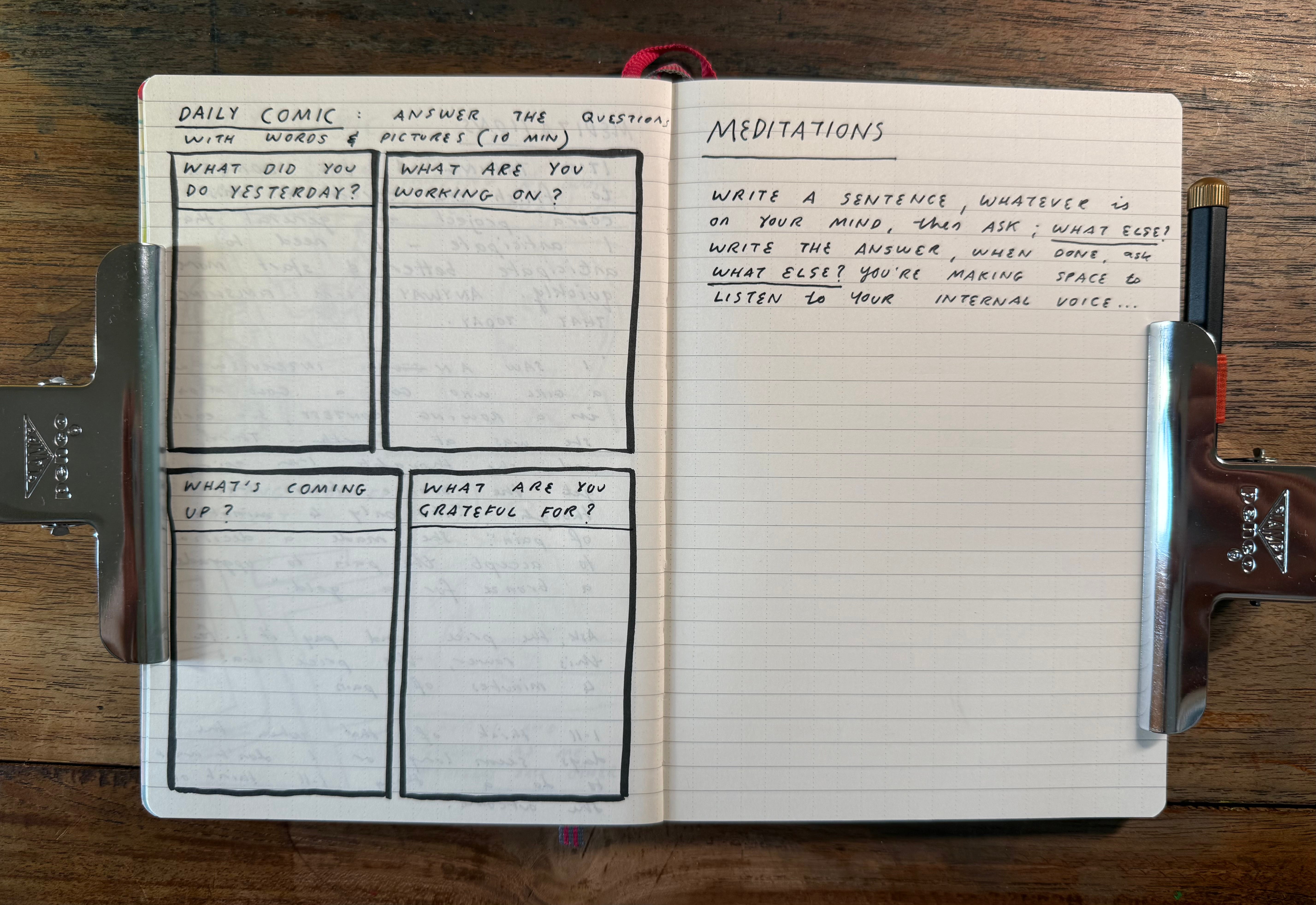
On the left page, we will start with an exercise you might now be familiar with which is the Ten Minute Visual Journal Method, it’s a starting point and we will evolve it each day.
Draw 4 squares, that serve as panels and use them to answer these 4 questions.
What did you do yesterday?
What are you working on?
What’s coming up?
What are you grateful for?
Grammar notes:
Notice how on my page the ‘gutter’ or space between panels don’t align on the top row and the bottom row. That is your first lesson in leading the eye, this method, leads across the page after the first panel instead of testing it to move downwards.
A present side effect is you can have frames of different proportions which can be useful for pacing and framing different subjects.
You see comics capture a series of moments, and the width of a panel is one way to make the moment linger, of flash by.
Primal Language:
Now fill the panels by answering the questions. Imagine yourself inside the panel experience in the moment, whether drawing the past or the future, draw it as if it’s the present. Enter the moment and live it on the page. If you imagine or remember a conversation from that scene, write it down.
Don’t over think it.