

You are now reading Day 4 of this FREE 5 day email course, where I give everything you need to start and maintain an artist diary.
Missed Day 1? Start there: Why it’s so easy to get ideas but so difficult to turn them into anything tangible.
The two biggest objections you will have.
1. What if I can’t draw?
If you’re reading this and maybe you come from more of a writing background, you might be wondering how you could start an artist diary if you can’t draw.
Well my answer would be to approch it the way a 4 year old would, just draw, and let what ever comes out come out, but if you want to nudge that in a direction, then do this.
Try to draw everything as simple shapes.
A head is a circle, a body is a rectangle or another circle hands and legs are lines. This will give you a modified stickman that Scriberia call ‘Brickman’.
Here’s how you make one.
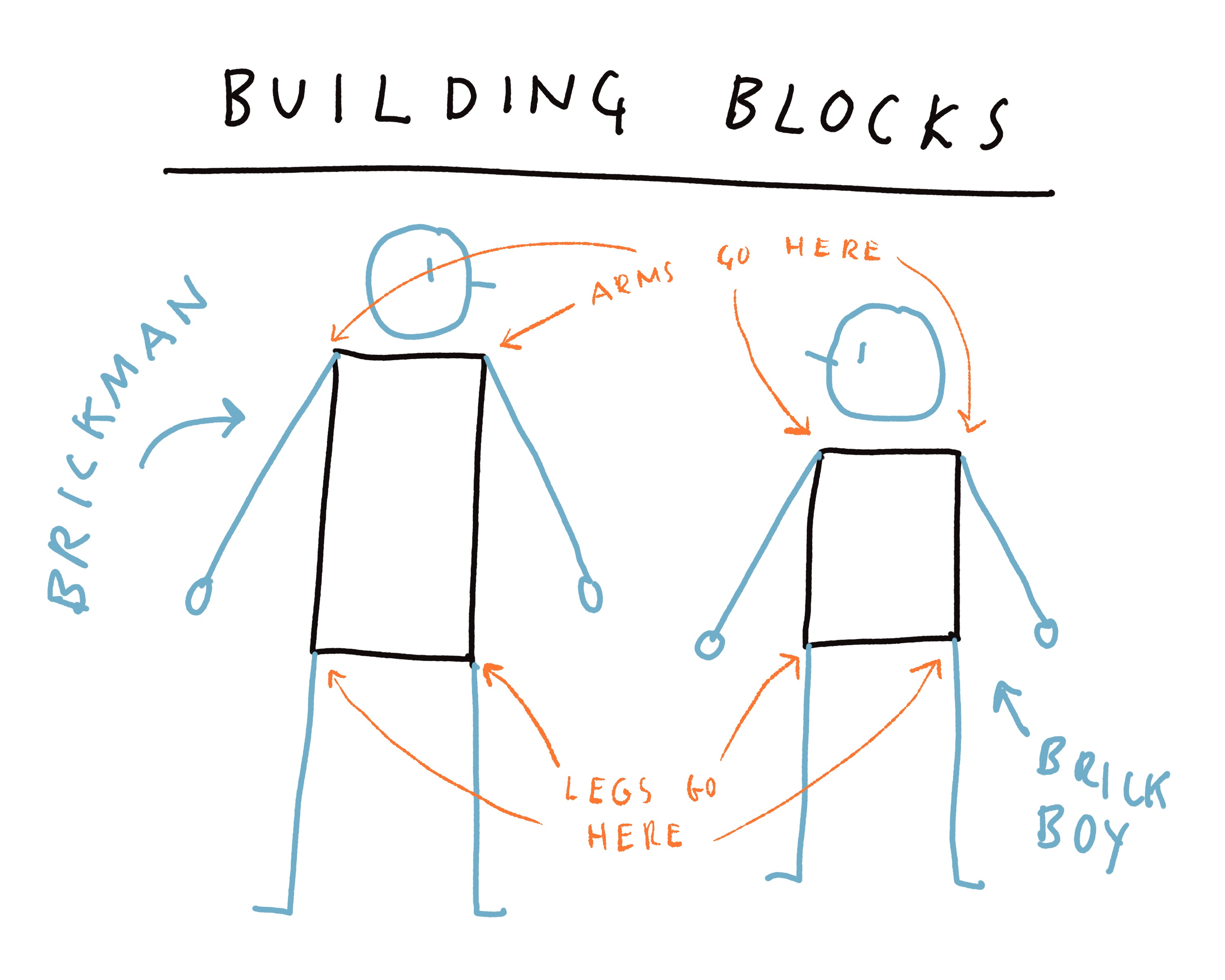
You can make the heads bigger and the limbs smaller for a more cartoony look in the style of Ivan Brunetti , or keep these action figure proportions. Make it your own.
Add pattern and details to your shapes to make them come alive. Drawing is easy if you start simple.
2. What if I can’t write?
Maybe this will help:
The Day You Became A Better Writer – by Scott Adams
I went from being a bad writer to a good writer after taking a one-day course in “business writing.” I couldn’t believe how simple it was.
I’ll tell you the main tricks here so you don’t have to waste a day in class. Business writing is about clarity and persuasion. The main technique is keeping things simple. Simple writing is persuasive. A good argument in five sentences will sway more people than a brilliant argument in a hundred sentences. Don’t fight it.
Simple means getting rid of extra words. Don’t write, “He was very happy” when you can write “He was happy.” You think the word “very” adds something. It doesn’t. Prune your sentences.
Humor writing is a lot like business writing. It needs to be simple. The main difference is in the choice of words. For humor, don’t say “drink” when you can say “swill.”
Your first sentence needs to grab the reader. Go back and read my first sentence to this post. I rewrote it a dozen times. It makes you curious. That’s the key. Write short sentences. Avoid putting multiple thoughts in one sentence. Readers aren’t as smart as you’d think.
Learn how brains organize ideas. Readers comprehend “the boy hit the ball” quicker than “the ball was hit by the boy.” Both sentences mean the same, but it’s easier to imagine the object (the boy) before the action (the hitting). All brains work that way. (Notice I didn’t say, “That is the way all brains work”?)
That’s it. You just learned 80% of the rules of good writing. You’re welcome.
If you do want to become a better writer, those ideas will get you 2 thirds of the way there, otherwise just write the way you write. Again it’s your artist diary written for you.
Here are two more tips of my own:
Write like you’re writing for someone else. That way when you read it later it will make sense.
And don’t leave things out.
If you’re copying a quote, write the name of its author too.
What other questions do you have?
DAY 4 Creative Action:
You don’t have to show people what’s inside your artist diary, but you can tell them about it.
I’ve made a space for you to share pictures, thoughts and questions about your Artist Diary with other Ten Minute Artists.
Your task for to day is to share the cover of your Artist Diary, say hello, and why you want to keep an artist diary. You can do that in the link below.
📆 Check your inbox again in 24 hours for Day 4. It’s time to say hi to other Ten Minute Artist, and have some of your questions answered by me and the community.

PS: Paid subscribers receive a Creative Spark every day in 2026, each spark contains an idea and a prompt that you can use with your artist diary. That’s 365 days of creative sparks! Part reminder, part slow drip of ideas, and a prompt every single day.
Here’s the entire 5-Day Course in case you missed a day or want to binge:
The Artist Diary
Day 1: What is an artist diary, and why you should keep one
Day2: What stops people from beginning or sticking to this practice
Day3: My three best Artist Diary Setups (repeatable prompts)