


Ideas come and go.
But in order to turn them into something tangible they need time and a place to grow. And this takes intentional cultivation. It’s an art. Or the work of an artist.
And even if you don’t think of yourself as an artist, this kind of work is accessible to you. All you need to do is start keeping what I call an artist diary.
This FREE 5 day email course, will give everything you need to start and maintain an artist diary.
What’s an artist diary? And what will it do for you.
As a young child I would draw on every surface I could fine. Through the years I learned all the surfaces I was not allowed to draw on. My world as a born artist was shrinking smaller and smaller.
Maybe this happens to everyone.
Instead of drawing on the walls with my mom‘s lipstick — every tool being an art material and every surface a canvas.
Art became something you could only do in art class once a week. And creative expression shrunk to the materials and subjects that the teacher decided to work on on that day.
At least I was drawing…
Maybe I went to art school so I could just continue drawing.
Of my cohort in art school, only a handful remained artist.
I was one of that handful graduates that still makes art.
And the thing that kept me going, was a little green hardcover book that I found in a bookshop one fateful day. It had blank pages and no further instructions.
That book was my world.
In it I made some of my best water colour pieces, I drew maps of places I went to with no roads, wrote love letters and prayers. It’s where I drew the recipie for my grandmother’s fish curry, and created the sketches for my very first paintings and sculptures.
And when all the pages were used up. I replaced it with a moleskine.
Since 1999 I’ve filled volume after volume after volume of what I now call Artist Diaries.
An artist diary is an everything book where ideas matter more than craft.
It’s an external log of your creative development.
If you don’t have an artist diary, I’m going to tell you why you need one. And if you have some kind of everything book where you mix drawing and writing (and more..) I invite you to call it an artist diary.
This is what an artist diary will do for you…
1. As soon as you start an artist diary you’re allowed to call yourself an artist.
“We are what we repeatedly do, therefore, excellence is not an act, but a habit” - Aristotle
Not just excellence, but anything we consistently do becomes our identity. By making art you declare yourself an artist. Your artist diary is a low lift way for you to start and keep making art. It’s a practice, that informs your art making while not being art in itself.
It is ‘the process’.
As soon as you start an artist diary you are declaring yourself an artist and the repeated use of the artist diary is how you remain an artist.
An artist diary is permission to make art daily and permission to start calling yourself an artist.
2. It’s an easy way to start your creative engine.
An artist diary is a quick and easy way to start your creative engine, to get yourself doing the habit anywhere at any time of day and in any kind of mood. All you need is a designated artist diary and something to draw and write with.
This is liberating. You don’t have to wait to get a fancy studio. You don’t need perfect materials. Fill a spread, a page or even just a line. No morsel of your creativity is too small to go into your artist diary.
Starting is always the hardest part and the biggest point of failure.
Your artist diary makes it easy to start by being always available and low stakes. Think of it as the fire starter to your creative practice.
3. Escape the formality and rigidity of traditional sketchbooks, journals and commonplace books.
You make an art diary for yourself.
It’s the starting point for personal art. You never need to ask if you’re doing it right because, there is no wrong way to make an art diary. Think of it as the home for yourself personal creative practice.
Break free from the pressure to live up to expectations.
This is not a perfectly formatted diary, or an aesthetic sketchbook.
This is the raw and ugly notebook that no one needs to understand but you.
I’ll be honest, sometimes as I look around at the perfect sketchbooks on social media I question myself as an artist. But everytime I ask someone with a perfect sketchbook or instagram how they do it, the answer is always.
“I only show the good stuff”.
That means there is another place where the ‘real work’ or at least the initial work happens. For some that’s an ugly sketchbook or a notebook. What we call an Artist Diary.
4. Write, draw and more!
Writing in a sketchbook or drawing in a journal feels weird - it just does.
But in an artist diary you can freely switch between writing and drawing regardless of your skill level.
Use writing, drawing (collage,painting,photography) not as art but as a means for collecting ideas. Combine and interchange media to produce completely unique spreads.
Maybe you’re an artist who’s tentative about writing or a writer who is tentative about drawing. This is where you build confidence and discover the creative thread that runs through everything you create.
5. Collect and Cultivate ideas
Turn daily encounters with the muse into tangible material.
If you make a habit of showing up to work, the muse will make a habit of visiting. And we can only take in so much with each visit. We need a place to collect and store ideas as they come.
Or maybe a better way to think about it is we need a nursery to plant these seeds of inspiration. Over time we can cultivate them into fully formed ideas.
It doesn’t matter how brilliant an idea is, if it’s note cultivated it will become lost and nothing will come of it.
6. Build a visceral record of your days
The benefits of a diary include:
A way to notice patterns
A tool for self awareness
A way to process your experience
A way to travel back in time or imagine a future
A way to capture fleeting and cherished moments
Diaries are great and adding a visual element to them makes them even more powerful. Art is powerful because it is personal. Your diary is a storehouse of personal material that you can weave over and over into your creative work.
Our life is built of moments, and one of life’s greatest pleasures is opening a diary and reliving some of these precious moments.
7. A creative lifeline
Whether you’re starting out or you’re hanging on to your creativity by a thread, or even if you’re an established artist needing a way to connect with what is truly you, and artist diary offers a lifeline.
How can you start and keep an artist diary?
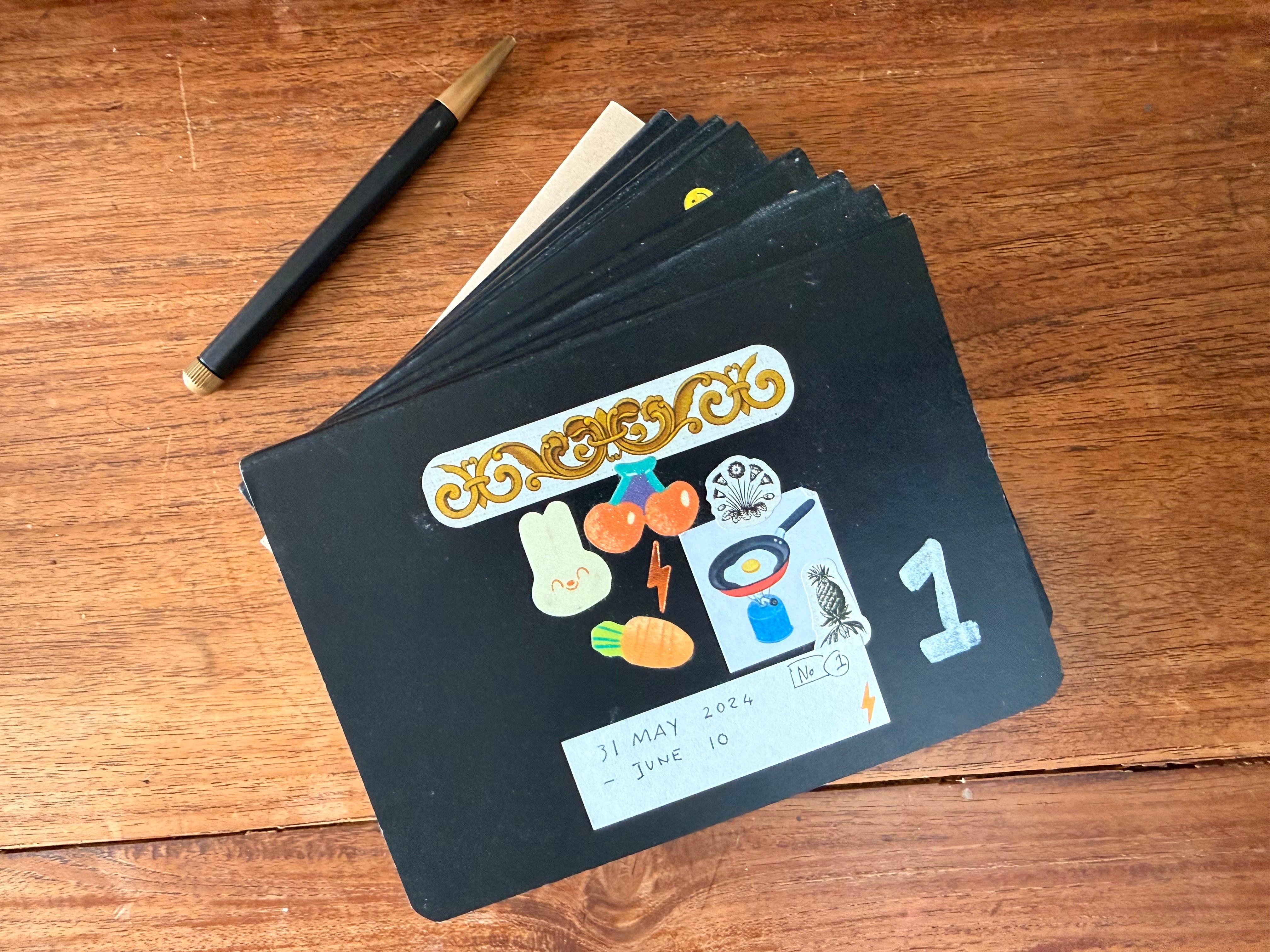
(If you’re new here)
Hi, I’m Adam Ming.
In 2022 I became a published illustrator at 41, (30 years after I learned the word ‘illustrator’ and declared I would do that for a living as a child.) I’ve since illustrated 12 books and have worked with all the big 5 publishers.
For there decades I strayed further and further from that ambition, but keeping an artist diary was the lifeline that stopped me from forgetting I was an artist altogether.
I’ve been keeping an Artist Diary for 26 years.
I had no idea what I was doing in the beginning but now it’s second nature.
As I go into my 27th year of keeping an artist diary I want to share the concepts templates and examples of what has worked for me and what I’ve discovered from others.
This FREE email course will give you everything you need to start and maintain an artist diary in just 5 short emails.
You’ll get one lesson a day for the next 5 days. (Lesson 2, it’ll be in your inbox tomorrow!)
By the end of 5 days you’ll know:
What makes an artist diary unique and different from sketchbooks, journals and other more formal modes of collecting and cultivating ideas.
What stops people from maintaining this powerful habit.
Exactly what goes into an artist diary
Whether this practice will work for you (spoiler alert, yes it will!)
Multiple ways (and examples) to approach your artist diary in just ten minutes a day
The first lesson is on Why it’s so easy to get ideas but so difficult to turn them into anything tangible.
The prompts inside will walk you through exactly how to set up your artist diary and make it your own.
DAY1 Creative Action:
Get a blank book and assign it as your artist diary.
I’ve tried many different form factors, but just like a camera, the best artist diary is one that you have with you.
So I recommend a portable format. These days I use an Open-flat notebook (A6 Grid from muji) It cost under $5 and has 80 pages. The combination of affordability and quality works well for me at this moment.
In the past I’ve used leuchtturm 1917 and moleskine which are nice, but I’m appreciating a more down to earth vibes of the muji notebook.
Other than portability, the other thing to consider is replenish-ability. It’s nice to have a shelf full of artist diaries that share the same form factor.
📆 Check your inbox again in 24 hours for Day 2

PS: Paid subscribers receive a Creative Spark every day in 2026, each spark contains an idea and a prompt that you can use with your artist diary to ignite your creative joy.
Here’s the entire 5-Day Course in case you missed a day or want to binge:
The Artist Diary
Day 1: What is an artist diary, and why you should keep one
Day2: What stops people from beginning or sticking to this practice
Day3: My three best Artist Diary Setups (repeatable prompts)
Love this idea, Adam. Looking back on my first few sketchbooks this is really what they were - somewhere along the way I have lost that as perfectionism and overthinking takes over! I’m going to follow along and get back into this - thanks for the inspiration. :)
Well Santa left me a cute sketchbook in my stocking and I was so intimidated to do a sketch in it.
Thanks for this gift from you!
I’ve recently retired and have dabbled with drawing and doing watercolor paintings and am enjoying learning techniques but am definitely intimidated. This artist diary is going to be just for my eyes and the creative side of my mind and we shall see what may transpire from there. Or not. Either way is good because it’s my diary!